To say it has been a stressful week is an understatement but I have survived my eight days in a row of work and now I have three blissful days off to relax and recover. Working in retail it's easy to get overwhelmed by the amount of crazy shoppers you encounter on a holiday weekend and to say I almost lose it sometimes is another understatement...it's hard to not yell at the people who yell at you and treat you like their personal assistant or the ones who throw clothes on the floor and trash tables. I just don't understand how someone can walk into a store and be so disrespectful to the people working there and create such a mess. Plus it drives me crazy that it was Memorial Day and as a country we choose to ignore the real meaning of the holiday and instead use it as an excuse to bargain shop. Sorry for the rant...I will move on. My point is that when I am having a stressful day or week it's amazing to come home to Winston and see how excited he is to have me home. He immediately grabs the nearest toy and runs circles around me with it in his mouth while he snorts and wags his curly tail. Just that little act of love and excitement he shows me makes everything a million times better. I know on Saturday he is going to be very excited because my husband and I are taking him to a huge Pug Event and I will make sure to take a ton of pictures to post! For now here are a few of him relaxing at home.
Showing posts with label pets. Show all posts
Wednesday, May 27, 2015
Monday, April 14, 2014
Meow Monday: Benefits of Spaying/Neutering
One of the most important health decisions you will make in your pet's life is whether to spay/neuter them. Spaying and neutering offer life-long health benefits to your pet which is why it is something you should have done. Spaying is where a female pet's ovaries and uterus are removed. Neutering is where the testicles are removed from your male pet. Each procedure is now easily affordable due to most states having low cost spay/neuter programs. I will provide a link to these at the end of the post. Here are some legitimate reasons to have your pet spayed/neutered.
+ Neutering not only prevents unwanted litters but it also prevents testicular cancer if done before six months of age.
+ Spaying your pet offers protection from uterine infections and breast cancer which is fatal in 90% of cats and 50% of dogs.
+ An intact male will do anything to find a mate which includes digging out of your yard which increases his chance of getting hit by a car or getting into fights with other males. If he is neutered he will not want to roam away from home.
+ A spayed female won't go into heat. Female felines usually go into heat four to five days every three weeks during breeding season. They will yowl and urinate more frequently - even all over the house - to advertise themselves to mates.
+ Unneutered dogs and cats tend to mark their territory by spraying strong smelling urine all over the house. They also tend to be more aggressive and these aggressive behaviors can be avoided by early neutering. A neutered male will be much better behaved.
+ The cost of spaying/neutering your pet is a lot less expensive than caring for a litter. It is also a lot more cost effective to spay/neuter than it is to pay for treatment when your unneutered pet gets into a fight.
+ Spaying/neutering your pet will not make them fat. This is an old excuse people use to not get their pet spayed/neutered. As long as you keep up your pet's exercise and don't overfeed - they will stay the same size.
+ It is good for the community to spay/neuter your pet. Don't add to the over population of pets. There are already so many strays out there. Every year millions of cats and dogs are euthanized or suffer as strays. Unplanned litters result in these high numbers and they could have easily been prevented by spaying and neutering.
+ If you think you are teaching your children a lesson on the miracle of birth by having a litter you are mistaken. Don't breed and add to the pet population when you can just go the less traumatic route and go to the library to teach your child about birth.
Here is a link for low cost spay/neuter programs across the country.
And of course a Meow Monday wouldn't be complete without pictures of my cats. Enjoy!
Obviously they all have a case of the Mondays. I was going to harass them with more pictures but they looked like they needed to catch up on some sleep since they kept me up most of the night playing and biting my feet. It's hard being a cat.
+ Neutering not only prevents unwanted litters but it also prevents testicular cancer if done before six months of age.
+ Spaying your pet offers protection from uterine infections and breast cancer which is fatal in 90% of cats and 50% of dogs.
+ An intact male will do anything to find a mate which includes digging out of your yard which increases his chance of getting hit by a car or getting into fights with other males. If he is neutered he will not want to roam away from home.
+ A spayed female won't go into heat. Female felines usually go into heat four to five days every three weeks during breeding season. They will yowl and urinate more frequently - even all over the house - to advertise themselves to mates.
+ Unneutered dogs and cats tend to mark their territory by spraying strong smelling urine all over the house. They also tend to be more aggressive and these aggressive behaviors can be avoided by early neutering. A neutered male will be much better behaved.
+ The cost of spaying/neutering your pet is a lot less expensive than caring for a litter. It is also a lot more cost effective to spay/neuter than it is to pay for treatment when your unneutered pet gets into a fight.
+ Spaying/neutering your pet will not make them fat. This is an old excuse people use to not get their pet spayed/neutered. As long as you keep up your pet's exercise and don't overfeed - they will stay the same size.
+ It is good for the community to spay/neuter your pet. Don't add to the over population of pets. There are already so many strays out there. Every year millions of cats and dogs are euthanized or suffer as strays. Unplanned litters result in these high numbers and they could have easily been prevented by spaying and neutering.
+ If you think you are teaching your children a lesson on the miracle of birth by having a litter you are mistaken. Don't breed and add to the pet population when you can just go the less traumatic route and go to the library to teach your child about birth.
Here is a link for low cost spay/neuter programs across the country.
And of course a Meow Monday wouldn't be complete without pictures of my cats. Enjoy!
Jasper showing a little tongue.
Jasper and Rusty being sleepy.
Charlie mid yawn.
Obviously they all have a case of the Mondays. I was going to harass them with more pictures but they looked like they needed to catch up on some sleep since they kept me up most of the night playing and biting my feet. It's hard being a cat.
Saturday, April 12, 2014
Happy Caturday
Winston and I hope everyone has had a great week but more importantly we wish everyone a happy Caturday! Winston celebrates every Caturday by spending extra cuddling time with his feline siblings. Sometimes I think he believes he is just one of the cats. I wanted to share some cute pictures I took this week of all four of the pets. Enjoy!
Jasper giving me attitude.
Charlie always has to be touching Winston when they are sleeping.
My beautiful Rusty. She is a sweetheart.
Charlie showing off his cute toes.
Winston sleeping with his eye open. He does this a lot.
Charlie's tummy makes the best chin rest.
Three out of four babies on the bed.
He jumps up here and waits by the front door until we get back home.
Jasper decided Charlie needed a bath in the middle of playing.
Princess Rusty. She knows she is royalty.
Charlie - a snowball with a cat head according to my dad.
The cutest face you will ever see.
Make sure you check back Monday for a new post! Have a great rest of the weekend and please check out my gofundme page on the right side. Thank you!
Wednesday, April 9, 2014
Winston Wednesday: The Great Outdoors
Living back in the beautiful Pacific Northwest with all the greenery makes it really easy to enjoy taking Winston for adventures outdoors. Winston loves the great outdoors. If he even hears the word "walk" he starts whining and jumping all over the place. He's quite the little character. The exercise is great for both of us and we always make sure we are prepared before we go out anywhere. Here are some tips to protect your dog when taking it outdoors for fun.
First you will need to make sure your dog is healthy enough for the physical exertion by taking it to your Veterinarian. You will want to get a thorough check up and make sure that all vaccinations are up to date. A rabies vaccination is required by law in all states and is extra important in case your dog encounters any wild animals such as raccoons, foxes, skunks or bats because they sometimes carry rabies. It is also important to get your dog started on a regimen of flea/tick prevention because they both can pose serious health risks. Fleas are also just itchy nuisances that multiple and spread throughout your house and yard. Ticks can carry a number of diseases which can also be transmitted to humans.
Once you have all of your preventative care out of the way you need to set aside the basics that are essential to a safe outdoor adventure. These basics include:
- Water and a bowl to keep your dog hydrated.
- ID tags on your dog's collar so that if your dog is able to be let off the leash or somehow got loose, it can then be identified by whoever finds it and returned to you. Also make sure that your current rabies tag is on the collar as well. It's a good idea to have your dog microchipped as well in case the collar somehow fell off and animal control got ahold of your dog they could then scan for a microchip and all of your information would come up.
- The night before your outing look up information on all the nearest emergency animal clinics to the location you will be at just in case your dog needs Veterinary attention.
- Pet specific First-Aid Kit (you can buy these from your local pet store or online)
This is just a list of the basics. There is always more that could be added depending on your specific surroundings. Stay safe!
First you will need to make sure your dog is healthy enough for the physical exertion by taking it to your Veterinarian. You will want to get a thorough check up and make sure that all vaccinations are up to date. A rabies vaccination is required by law in all states and is extra important in case your dog encounters any wild animals such as raccoons, foxes, skunks or bats because they sometimes carry rabies. It is also important to get your dog started on a regimen of flea/tick prevention because they both can pose serious health risks. Fleas are also just itchy nuisances that multiple and spread throughout your house and yard. Ticks can carry a number of diseases which can also be transmitted to humans.
Once you have all of your preventative care out of the way you need to set aside the basics that are essential to a safe outdoor adventure. These basics include:
- Water and a bowl to keep your dog hydrated.
- ID tags on your dog's collar so that if your dog is able to be let off the leash or somehow got loose, it can then be identified by whoever finds it and returned to you. Also make sure that your current rabies tag is on the collar as well. It's a good idea to have your dog microchipped as well in case the collar somehow fell off and animal control got ahold of your dog they could then scan for a microchip and all of your information would come up.
- The night before your outing look up information on all the nearest emergency animal clinics to the location you will be at just in case your dog needs Veterinary attention.
- Pet specific First-Aid Kit (you can buy these from your local pet store or online)
This is just a list of the basics. There is always more that could be added depending on your specific surroundings. Stay safe!
Happy Winston Wednesday!
Tuesday, April 8, 2014
Most Common Toxic Plants to Cats and Dogs
Overall there are 405 toxic plants to cats and dogs combined. It would be insane for me to list all of them so I am going to list the most common plants to cause toxicity - the ones they get into most frequently. I will include a picture of the plant and a list of symptoms when ingested.
Scientific Name: Aloe Vera
Family: Liliaceae
Toxicity: Cats and Dogs
Clinical Signs: Vomiting, depression, diarrhea, anorexia, tremors, change in urine color.
Scientific Name: Amaryllis sp.
Family: Amaryllidaceae
Common Names: Belladonna lily, Saint Joseph lily, Cape Belladonna, Naked Lady
Toxicity: Cats and Dogs
Clinical Signs: Vomiting, depression, diarrhea, abdominal pain, hypersalivation, anorexia, tremors
Scientific Name: Rhododendron sp.
Family: Ericaceae
Common Names: Azalea, Rhododendron, Rosebay
Toxicity: Cats, Dogs, Horses
Clinical Signs: Ingestion of a few leaves can cause serious problems. The toxic principle interferes with normal skeletal muscle, cardiac muscle and nerve function. Typically within a few hours of ingestion clinical signs begin such as digestive upset, excessive drooling, anorexia, diarrhea, depression, loss of coordination, weakness, stupor, leg paralysis, weak heart rate and recumbency for 2 or more days at which point may result in a coma and then death.
Scientific Name: Colchicum autumnale
Family: Liliaceae
Common Names: Autumn Crocus, Meadow Saffron
Toxicity: Cats, Dogs, Horses
Clinical Signs: Oral irritation, bloody vomiting, diarrhea, shock, multi-organ damage, bone-marrow suppression.
Scientific Name: Begonia spp.
Family: Begoniaceae
Common Names: There are over 1,000 species and 10,000 hybrids
Toxicity: Cats and Dogs
Clinical Signs: Oral irritation, intense burning and irritation of mouth, tongue and lips, excessive drooling, vomiting, difficulty swallowing. The tubers are the most toxic part of the plant.
Scientific Name: Ricinus communis
Family: Euphorbiaceae
Common Names: Castor Bean Plant, Castor Oil Plant, Mole Bean Plant, African Wonder Tree
Toxicity: Cats, Dogs, Horses
Clinical Signs: Castor Beans are very toxic and cause oral irritation, burning of mouth and throat, increase in thirst, vomiting, diarrhea, kidney failure, convulsions. As little as one ounce of seeds can be lethal. Signs typically develop between 12 to 48 hours after ingestion and include loss of appetite, thirst, weakness, sweating, difficulty breathing, trembling, loss of coordination, progressive central nervous system depression, and fever. As the syndrome progresses bloody diarrhea may occur as well as convulsions and a coma can precede death.
Scientific Name: Anthemis noblilis
Family: Compositae
Common Names: Chamomile, Manzanilla, Garden Chamomile, Roman Chamomile, True Chamomile, Corn Feverfew, Barnyard Daisy, Ground-apple, Turkey-weed
Toxicity: Cats, Dogs, Horses
Clinical Signs: Contact dermatitis, anorexia, diarrhea, vomiting, allergic reactions. Long term exposure can lead to bleeding tendencies. *NOTE* Just because Chamomile calms and relaxes you...that does NOT mean that you can give it to your pets. I have heard of a few people who thought it was a great thing to give to their dogs. They thought it calmed their dogs...well yeah because you were slowly poisoning them.
Scientific Name: Cyclamen spp
Family: Primulaceae
Common Names: Cyclamen, Sowbread
Toxicity: Cats and Dogs
Clinical Signs: Vomiting, diarrhea, salivation. The highest concentration of the toxic component is in the root of this plant. Heart rhythm murmurs can occur and fatally.
Scientific Name: Allium sativum
Family: Liliaceae
Common Names: Garlic, Stinking Rose, Rustic Treacle, Comphor of the Poor, Nectar of the Gods, Serpet Garlic, Rocambole
Toxicity: Cats, Dogs, Horses
Clinical Signs: Breakdown of red blood cells (hemolytic anemia, Heinz body anemia), vomiting, weakness, blood in urine, panting, tachycardia (high heart rate).
Scientific Name: Cannabis sativa
Family: Cannabaceae
Common Names: Marijuana, Hashish, Indian Hemp
Toxicity: Cats, Dogs, Horses
Clinical Signs: Prolonged depression, incoordination, vomiting, sleepiness or excitation, dilated pupils, hypersalivation, low blood pressure, low body temperature, seizure, coma, death in rare cases.
Scientific Name: Nerium oleander
Family: Apocynaceae
Common Names: Oleander, Rose-Bay
Toxicity: Cats, Dogs, Horses
Clinical Signs: Poisonings of Oleander can occur from access to fallen branches and prunings. All parts of the plant contain a highly toxic cardiac glycoside and can cause diarrhea, colic, sweating, incoordination, shallow/difficult breathing, muscle tremors, recumbency, and possibly death from cardiac arrest.
Scientific Name: Epipremnum aureum
Family: Araceae
Common Names: Pothos, Golden Pothos, Devil's Ivy, Taro Vine, Ivy Arum
Toxicity: Cats and Dogs
Clinical Signs: Oral irritation, intense burning and irritation of mouth, tongue and lips, vomiting, excessive drooling, difficulty swallowing.
Scientific Name: Cycas revoluta, zamia species
Family: Cycadaceae
Common Names: Sago Palm, Coontie Palm, Cardboard Palm
Toxicity: Cats, Dogs, Horses
Clinical Signs: Vomiting, melena (black "tarry" feces associated with a gastrointestinal hemorrhage), icterus (jaundice; yellow color of skin, eyes, mucous membranes), hemorrhagic gastroenteritis, bruising, excessive thirst, coagulopathy (condition in which the blood's ability to clot is impaired), liver damage, liver failure, death.
Scientific Name: Tulipa species
Family: Liliaceae
Common Names: Tulip
Toxicity: Cats, Dogs, Horses
Clinical Signs: Highest concentration of toxin is in the bulb. If ingested vomiting, depression, diarrhea, cardiac abnormalities and hypersalivation will occur. *NOTE* If you have a dog who likes to dig and you have Tulips in your backyard be very careful and watch your dog.
Scientific Name: Taxus sp.
Family: Taxaceae
Common Names: Yew, Japanese Yew
Toxicity: Cats, Dogs, Horses
Clinical Signs: Sudden death from cardiac failure. The early signs are: muscular tremors, dyspnea, and seizures in dogs.
These are some of the most common plants that cause high risk toxicity to cats and dogs. I didn't include many Lilies because there are so many varieties but the more dangerous, potentially fatal lilies are true lilies of the Lilium or Hermerorcallis species. Some examples of these dangerous lilies include: Asiatic hybrid, Day, Easter, Red, Japanese Show, Tiger and Stargazer. All of these are highly toxic to cats. Even a small ingestion of 2-3 petals or leaves can result in severe, acute kidney failure. Even the pollen or water from the vase! Lily of the Valley is another dangerous lily but it does not cause kidney failure, it can instead cause life threatening heart arrythmias and even death when ingested by cats and dogs. If you see your cat or dog ingesting any plant and you are not sure whether it is toxic please take your pet to the Veterinarian immediately. The sooner you take them to the Vet after they ate the plant the sooner they can be treated and have a better chance of a full recovery.
Thursday, March 6, 2014
Winston Loves His Sheep
Sorry I have sucked at posting on here! Things have been hectic with house hunting and then l have been helping out taking care of my mom because she had surgery last Friday. So to make it up to you I am going to share a cute video of Winston playing with his new sheep toy he picked out. Alex and I took him to Petco last week and he gravitated towards this toy so I took it off the shelf for him and he instantly grabbed it. He would have carried it all the way to the registers but he kept dropping it and I don't know how dirty their floors are so I ended up carrying it for him. Anyways, here is a cute little video of Winston playing with it and then some cute pictures I got of him with it.
He's precious. There is no denying it. Well I hope everyone has a great day and Winston sends you tons of Pug kisses!
Friday, March 22, 2013
Pets Provide Entertainment
As you can see from this blog I truly love my pets! They provide me with love and entertainment when I need it the most. Case in point...Charlie the newest member of my family is the weirdest cat I have ever encountered. Now cats are just weird in general but it's their many quirks that makes me love them so much. Charlie is extra weird though. Want proof? Watch the video below of him biting Winston's neck and humping him! This is the second time it's happened if you want to see the first one that is a little longer just go to my YouTube account.
I also wanted to use this post to let everyone know I recently decided to go back to my old job at a Vet Clinic. I will only be working two days a week but I am excited because I truly work with great people and for a great company. Okay, now I am going to leave you with this cute picture...
Thursday, March 21, 2013
Heartworms 101
I am often surprised by how little people really know about heartworms and the risk they pose to their dogs. I have worked in the Veterinary industry off and on and even went to school to be a Vet Tech so I have a lot of base knowledge about diseases and the health of pets. One of the biggest risks posed to your dog is heartworms. In this post I will go over heartworms and how to prevent them.
What are heartworms?
Heartworm is a parasitic worm that is passed to a dog through a mosquito bite. Heartworms reside in a dog's pulmonary arteries which causes damage to their lung tissue and vessels.
Where are heartworms?
Heartworms are found all across the United States. Wherever there are mosquitoes there are heartworms.
What are heartworms?
Heartworm is a parasitic worm that is passed to a dog through a mosquito bite. Heartworms reside in a dog's pulmonary arteries which causes damage to their lung tissue and vessels.
Where are heartworms?
Heartworms are found all across the United States. Wherever there are mosquitoes there are heartworms.
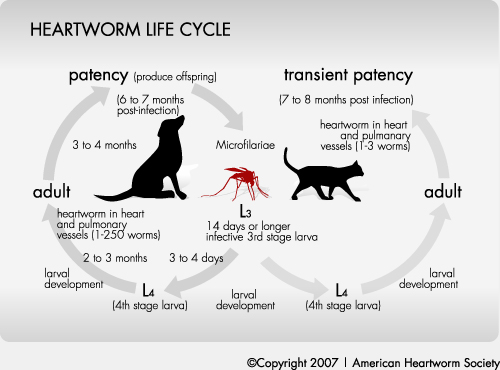
![]() |
| http://www.heartwormsociety.org/pet-owner-resources/heartworm.html#history |
What is the life cycle of heartworms?
Adult female heartworms release their young (microfilariae) into an animal's bloodstream. Mosquitoes become infected with the microfilariae when they take blood from an infected animal. It takes 10-14 days for the microfilariae to mature into the infective larval stage inside a mosquito. Once that happens when the mosquito bites another dog or susceptible animal the infective larvae enter into the bite wound. It then takes around 6 months for the infective larvae to turn into adult worms. Microfilariae are not able to mature into adult heartworms until they first pass through a mosquito.
What are the signs of heartworms in a dog?
Clinical signs of heartworm disease are hard to recognize in the early stages but as the number of the heartworms increases over a period of months and sometimes years the symptoms become more prominent. Dogs who are recently infected usually show no signs where as a dog who has been infected for a while might have a mild persistent cough, lethargy, become easily fatigued, have a decrease in appetite and even weight loss.
How is heartworm disease detected?
Heartworm disease is detected by a snap test that your veterinarian can perform with only 3 drops of blood. The test uses an antigen to detect heartworms. Keep in mind though that it may take up to 7 months of infection for a test to show positive. Most veterinarians offer two tests, one which tests only for heartworms (referred to as a 1dx test) and another that tests for heartworms as well as three tick borne diseases (known as a 4dx test). In most cases you will want to do the 4dx test if you have never had your dog tested and have never had them on preventative. You will especially want to do the 4dx test if you have a large tick problem. The snap test only takes 10 minutes and while they wait for the results of that a technician will smear some of the blood onto a slide and look under the microscope to see if there are any microfilariae.
If the test is negative what do I do?
If the test comes out negative then you want to start your dog on heartworm prevention. This is a monthly pill that will prevent your dog from becoming infected. There are many different brands of heartworm preventative but the most common ones are Iverheart and Heartgard. Another preventative option is Trifexis which has a flea preventative in it as well. Personally I have Winston on Trifexis because it is cheaper in the long run because I don't have to buy one thing for fleas and another for heartworms. Remember that all of these products require a prescription from your Veterinarian in order to get them.
What if the test comes back positive?
Adult heartworms are killed with a drug that is injected into the muscle through a series of treatments. Usually a dog is kept at the hospital the day of the injection just to make sure no adverse reactions take place. When the dog goes home it should be exercise restricted and taken outside on a leash so it can't run around. You will want to restrict exercise for about 2 months. To prevent another infection a monthly heartworm preventative will be given. The heartworm pill will also kill any microfilariae. A positive test may not seem like a huge deal but in reality the treatment can be pretty expensive and heartworms can cause permanent damage.
In conclusion...
Make sure you consult your veterinarian about heartworms because they know how prevalent it is where you live and will be able to tell you much more than I can. The most important thing to take away from this post is that heartworms are a real concern and can cause many problems. You should test your dog once a year and keep them on preventative year round.
Tuesday, March 19, 2013
Introductions
My name is Jacquelyn and I am the mother to a handsome Pug named Winston and his three kitty companions Rusty, Jasper and Charlie. I am 23 years old and married to an amazing man named Alex who is in the Navy. We are originally from Washington but are currently living in the midwest. I am a stay at home wife so I spend all my time with Winston and he keeps me thoroughly entertained and happy. This blog is to chronicle our day to day life and the shenanigans Winston gets into. To start off the introductions lets put a face to all these names!
This is a picture of my husband and I on our wedding day almost 3 years ago.
Here is Rusty our 14 year old cat...she is my darling girl who my dad and I rescued after our neighbors in Washington up and left in the middle of the night leaving poor Rusty behind. I have had Rusty since 6th grade.
This is Jasper who is going to be 3 this year. Alex and I adopted him when he was 8 weeks old at the Humane Society.
This is Charlie who is about a year and a half. Alex and I rescued him from a neglectful owner who was living across the street from us. He never fed Charlie and treated him horribly. The guy ended up losing his house and left Charlie behind so Alex and I took Charlie in. He is currently fighting an infection in his leg from what the vet thinks is a bite wound.
And last but not least this is Winston who will be 3 years old on April 28th. Alex and I have both always loved Pugs and wanted one so after being married for about 5 months we decided to get one. We found Winston and fell in love with him instantly. We really went to just look at Pugs but ended up loving Winston so much we bought him. It was kind of a spur of the moment decision and it is the best decision we have ever made!
Well that is all of us! I hope to use this blog to show how much my pets mean to me and to include meaningful posts not just about them but also about life in general.
Subscribe to:
Posts (Atom)


.jpg)